
The project “Turnton Docklands” presents an immersive future that, despite crises, makes hope, community, and new forms of coexistence tangible.
Since 1979, Ars Electronica has been doing pioneering work—building bridges between disciplines, serving as a platform for new alliances, and providing impetus for an open, inclusive dialogue about our future. In collaboration with artists from around the world, we realize and present projects that challenge conventions and anticipate developments.
For this series, we ask members of the Ars Electronica team to delve into our archive—the world’s largest of its kind—and select a project that has personally touched, inspired, or provoked them, and to tell us why this project is relevant today. Together, we embark on a journey to milestones of the so-called digital revolution. Milestones that were cutting edge.
In this edition, Christl Baur, Head of Ars Electronica Festival, gives us insight into a project that paints a surprisingly hopeful picture of the future and invites us to rethink our own ideas about tomorrow.

Which project did you choose?
Christl Baur: When I was asked to select a project from the extensive Ars Electronica archive for the “Cutting Edge” series, I immediately realized how challenging this task would be. Countless works appeared before my inner eye—visionary, style-defining, or radical—each of which pushed boundaries, anticipated technical developments, or shaped entire discourses in its own way. Choosing just one was correspondingly difficult.
In the end, I decided on “Turnton Docklands”—a project that has remained particularly impressive in my memory. Presented at the Ars Electronica Festival 2017, it was created by the Linz-based artist collective Time’s Up, which has been developing experimental situations and so-called “physical narratives” in the port of Linz for many years. Turnton Docklands is one of their most ambitious works: an immersive narrative world involving over 50 people, which transformed the basement of the LENTOS Kunstmuseum into a fictional yet astonishingly realistic harbor district.

Tell us what this project is about.
Christl Baur: In “Turnton Docklands,” visitors enter a harbor district in the year 2047. The starting point is grim: ecological tipping points have been exceeded, coastal cities are struggling with toxic waters, collapsing ecosystems, and extreme weather events. But instead of creating a pure dystopia, Time’s Up develops a fascinating counter-model. In the fictional coastal city of Turnton, a community has emerged that is finding new ways of living together in the face of crisis—solidary, self-organized, transparent, and supported by a sustainable economy.
The space itself becomes a narrative medium. Time’s Up has not created a classic installation here, but rather a walk-in narrative: a densely woven network of objects, documents, media, sounds, and spatial situations. Visitors encounter laboratories, government offices, and workshops, a harbor bar, news articles and diaries, technical devices, maps, food, and countless everyday details that together form a complex picture. Everything can be touched, read, tried out, or examined. The story unfolds not head-on, but through slow, curious immersion.
Time’s Up refers to this method as “physical narratives”—walk-in narrative forms that are neither linear nor conveyed by performers. They are created through spaces and objects, through clues, atmospheres, and condensations. What is told emerges from the visitors’ inquiring gaze – and from the conversations they have with each other on site. It is a narrative style that combines empiricism, fiction, and imagination, turning the audience into active interpreters. Nothing remains a backdrop; every detail is part of a larger web of meaning.

Why is this project so outstanding?
Christl Baur: For me, “Turnton Docklands” is a rare example of a vision of the future that does not get bogged down in alarmism. The ecological situation in 2047 is dire—collapsed ecosystems, toxic coastlines, extreme weather—but the project shows that even dystopian environmental conditions can give rise to social utopias. Neoliberalism and growth dogmas have been overcome; an economy oriented toward the common good has established itself; sustainable technologies shape everyday life. Turnton is home to laboratories that break down plastic particles in the sea, algae farms such as the Ocean Recovery Farm, which clean the waters and produce food, and institutions such as the New Neighbors Integration Bureau, which sees migration as a resource and cultural diversity as a strength. Here, the future does not appear as a monolithic destiny, but as a plurality of possible developments that arise through action, error, adaptation, and courage.
At the same time, the project impresses with its enormous depth of detail. Every corner of Turnton tells a story: the Medusa bar with its algae-based drinks; the office of the port coordination center; the announcement of a cultural festival to strengthen the neighborhood; the workshops of the Upcycling Center; or the subtle hints of a global political realignment. Time’s Up makes the fiction so believable that visitors forget they are not actually in a real port district. Many stay for hours, immersing themselves, talking to each other, developing hypotheses—and bringing their own stories into the world of Turnton.
Amidst all the serious questions about the future, there are also charmingly humorous moments – such as the elevator that only simulates movement, even though it doesn’t move a millimeter. It is precisely this mixture of depth, seriousness, and playful irony that makes the experience so accessible and inspiring.
“Turnton Docklands” does not invite passive consumption, but challenges the audience to become researchers themselves: to observe, discover, combine, and track down connections. The narrative is so multi-layered that it never becomes completely exhausted. With each visit, it opens up new levels and perspectives – and thus remains a living, ever-changing scenario for the future.

To what extent is it relevant today?
Christl Baur: Today, more than ever, it is clear how accurately Turnton Docklands anticipated certain developments. Ecological predictions that seemed speculative in 2017 have in some cases come to pass at an accelerated pace: extreme weather, species extinction, geopolitical tensions—The Great Acceleration has become reality. At the same time, we are experiencing social unrest that the project anticipated almost prophetically: dwindling certainties, polarized political landscapes, a coexistence of resignation and new beginnings. Turnton Docklands responds to this not with fatalism, but with the question: What future do we want to actively shape? And what does it mean to make decisions today that make hope possible in the first place?
The project brings to life what Rebecca Solnit so precisely formulated: Hope is not optimism, but an invitation to action. Turnton shows a future that only exists because people – looking back from the year 2047 – realized: “Change was our only chance.” This insight gives the work an almost urgent immediacy.
For me, “Turnton Docklands” is a milestone in immersive futurology—an example of how “futuring” can function as a spatial practice by making the future not only conceivable, but physically experienceable. The project impressively demonstrates that futures are negotiable and changeable—and that change begins on a small scale: in everyday decisions, attitudes, and actions. This is precisely where its power lies.
The installation warns of the consequences of our current actions, but at the same time opens up spaces of encouragement. It shows that even fragile future scenarios remain malleable. For me, “Turnton Docklands” proves that art can be an essential tool not only for reflecting on alternative futures, but also for actively imagining them – and thus making them possible.
Christl Baur – thank you!
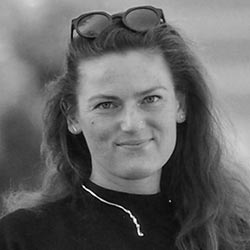
Christl Baur
Christl Baur is Head of Ars Electronica Festival, a researcher with an interdisciplinary background in art history, cultural management, and natural sciences. She is particularly interested in the connection between aesthetic and social practices that revolve around collaboration and experimentation and challenge social, political, and economic protocols. Her research covers topics such as video art, new media technologies, computers, biotechnology, and interactive art, and she works at the intersection of art and science. She collaborates closely with artists whose practice lies at the intersection of art, science, and technology.