Progress is much more than just technological advancement—it is a lengthy and complex social process. Art plays an important role in this.
When we talk about progress, we think of new gadgets and scientific breakthroughs, visionary inventors and ambitious founders—we think of the myth of the ingenious product, the unique genius, the big moment. It’s a narrative on which Silicon Valley has built an empire, and it’s undoubtedly a great one—dramatic, heroic, easy to celebrate.
But what if real progress happens in a completely different way? What if it happens much more slowly and quietly, and is driven by a very different and very large number of people?
What we often overlook
Real change rarely begins with the viral presentation of a spectacular new tool. It unfolds slowly—through the mostly invisible work of continuous adaptation and integration. It is rarely the inventions themselves that change the world, but rather the many processes that make them usable, stable, scalable, and thus meaningful.
This sometimes long, but always rocky road – or in other words, the time it takes for societies to adopt, reinterpret, and normalize new technologies – brings about change. Fire, writing, the steam engine, electricity, computers, the internet, and now artificial intelligence: none of these technologies changed our civilization overnight. It took years, often decades, for them to unfold their effects – and bring about progress.
Technology needs society; society needs technology.
Although we love to celebrate invention, discovery, and creative destruction because they symbolize a moment of departure, progress—in the sense of a safer, healthier, richer, and more fulfilling reality for people—is more about the “exploitation” of new tools or ideas: the long, patient process of iteration, integration, and refinement. American futurist and president of the Institute for the Future, Roy Amara, summed it up: “We overestimate the impact of a technology in the short term and underestimate it in the long term.”
Progress happens when we integrate new tools into our everyday processes—into our organizations, business models, legal systems, administrations, and relationships. It is promoted by engineers who fix bugs and users who try things out, by founders who experiment with new products and business models, by politicians who pass amended laws, and by teachers who impart new perspectives and new knowledge.
But progress also comes from artists who reflect on how new technologies and their application are changing our view of humanity and the world, and explore how we can use technologies beyond the profit-oriented intentions of their inventors. Platforms such as Ars Electronica, in turn, make their work visible, invite discussion, and initiate a broad dialogue. Art plays an essential role in moderating change.
Options and decisions
New technologies alone do not change the world; they merely create opportunities. Their very first applications often concentrate power and capital and increase inequality. Only when society responds—and finds ways to rebalance scope for action, prosperity, and co-determination—does progress emerge, not just technological progress, but social progress. “Tell me what technology you have, and I’ll tell you what kind of society you are,” wrote political theorist Langdon Winner in 1980 in “Do Artifacts Have Politics?”
Artists play an essential role in this process. They explore how technology can be used meaningfully. They explore what is socially, aesthetically, and politically possible. But they also examine how technology changes us—how it shapes our view of ourselves and the world we inhabit and shape.
Build community
The digital revolution began with the promise of ultimate democratization. Everyone would be connected, everyone would have a voice, everyone would be heard. Digital technologies promised to overcome all barriers.
That things turned out differently was neither inevitable nor inherent in the technology itself. It was the result of our decisions about how we want to design, manage, and use technology. But that is precisely why we can (and still) decide differently.

One example is Café DAWN in central Tokyo—a place where people with physical or mental disabilities can work, communicate, and participate in public life thanks to remote-controlled robots. Using a cell phone, tablet, or eye control, they can control their robot from anywhere in the world and talk to guests in the café through it. Here, technology does not stand for efficiency and productivity, but for inclusion, self-determination, and shared presence. Café DAWN shows what progress looks like when empathy, technology, and design come together and put people and their needs at the center.
The café creates added value for everyone: people who no longer had the opportunity to participate in social life regain a meaningful and purposeful role. Guests, in turn, are not only served coffee, but suddenly experience genuine encounters that open up new perspectives for them. And: The business is also economically successful – co-founded by Kentaro Yoshifuji in 2021, Café DAWN will be in the black from 2023.
In an interview with The Independent, Kentaro Yoshifuji says: “New ideas have little effect on their own because they are often not understood or accepted. But when you build something, when you bring it to life, some people will accept it. Then they begin to understand.”
Strengthening social identities
There is a lot of talk about identity these days—especially our digital identity. The more time we spend online, the more we post, share, and comment on social media, the more detailed the digital image of us becomes. Some people shape this image very consciously—politicians, CEOs, influencers. But most of us keep a rather chaotic diary: photos, videos, thoughts, fragments—an archive of our everyday lives that not only influences how others see us, but also how we remember ourselves. “Memories are the architects of our identity,” says Pau Aleikum Garcia, co-founder of the design studio Domestic Data Streamers (DDS).
In 2015, Pau Aleikum Garcia worked with Syrian refugees and experienced for the first time what it means when people lose not only their homes but also all visible traces of their past. When generative AI emerged in 2019, he wondered whether this technology could help create visual representations of lost memories.
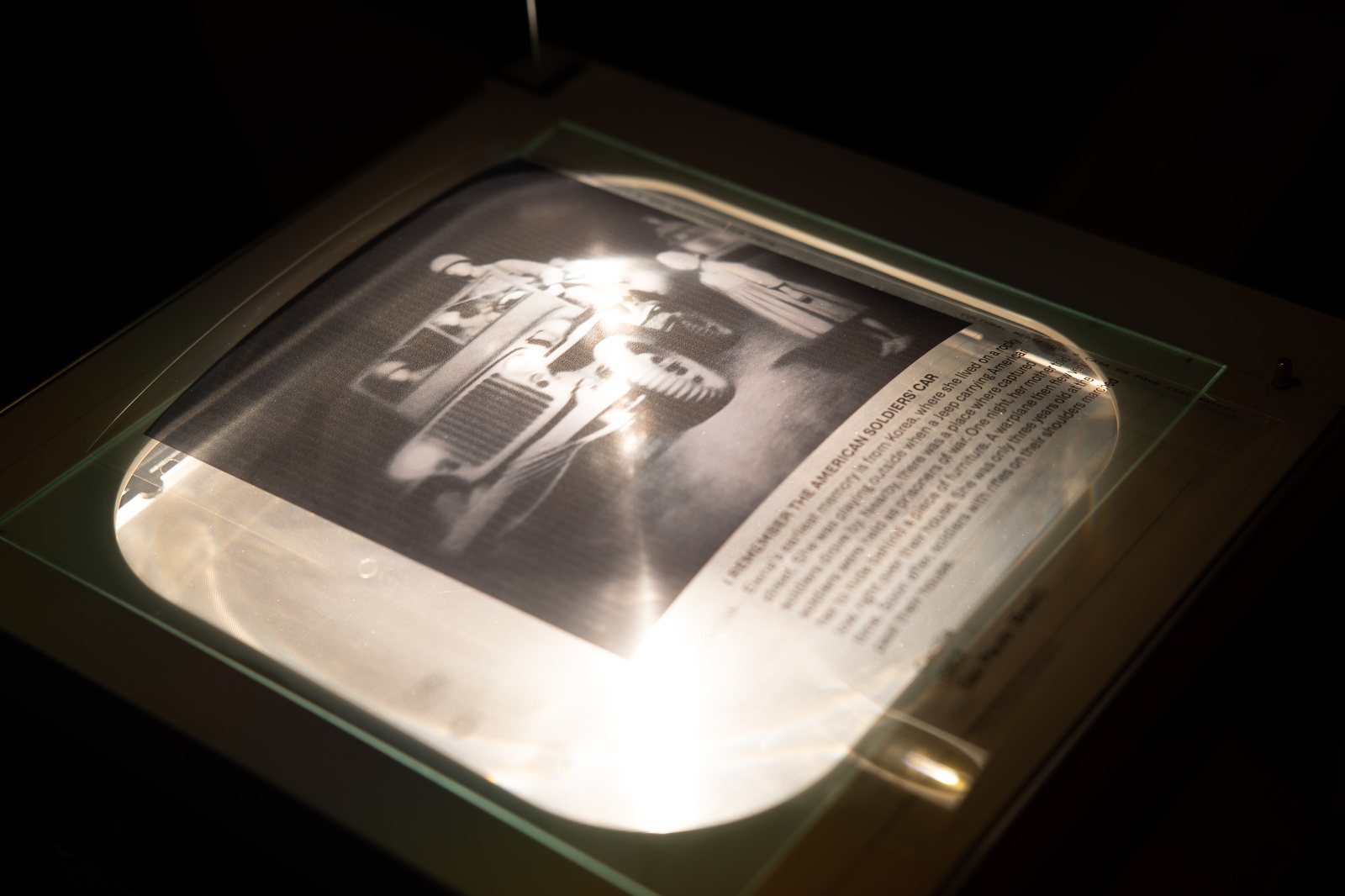
In 2022, he launched Synthetic Memories: interviewers talk to older people in particular about their life stories. Key episodes and moments in these narratives are then transformed by prompters into AI-generated images, which are adapted and refined until they feel “right” to the narrators.
While details such as surroundings, clothing, and hairstyles are depicted as accurately as possible, the faces are intentionally blurred. “We wanted a model full of imperfections,” says Garcia, “because it shows well how memory works.”
Synthetic Memories is not about recreating the past. It’s about giving form to the invisible architecture of memory. The project supports people and communities whose history is at risk. And it serves a greater purpose by reminding us that technology can foster genuine and meaningful dialogue between cultures and generations.
Promoting civil society
Thanks to generative AI, it has never been easier to tell stories. Texts, images, songs, videos—today, everything starts with a prompt. The result is a flood of content that is becoming increasingly “better”—more coherent, more realistic, more convincing, though not necessarily more creative or interesting.
The line between ‘real’ and “generated” is becoming increasingly blurred. We live in a time of eroding truth and dwindling trust.
Many think of the internet – and social media in particular – as a jungle of disinformation and noise. But it can also be understood differently: as an opportunity to clear and shape this jungle, doing things that were previously reserved for states and corporations.
One person who sees it this way and lives by it is Eliot Higgins, founder of Bellingcat—a collective of committed citizens, experts, journalists, and investigators.
When a Malaysia Airlines Boeing 777-200ER was shot down over Ukraine on July 17, 2014, while flying from Amsterdam to Kuala Lumpur, Bellingcat was among the first to gather and present evidence of who was responsible for this crime and the deaths of 298 people.
Bellingcat is reinventing investigative journalism for the internet age. The initiative is a kind of intelligence agency for everyone, using open-source intelligence (OSINT) techniques to analyze all kinds of publicly available data—from news and satellite images to forum posts and social media content.
For Bellingcat, the internet is a vast archive of evidence—a digital commons that can be used to uncover crimes, expose disinformation, and hold powerful people accountable. The initiative’s work shows how digital technologies, when used collaboratively and transparently, can empower citizens and strengthen civil society. “We build networks, we train people, we empower them to investigate. Critical thinking makes democracy more resilient,” says Eliot Higgins.
Achieving greater biodiversity and empowerment
No matter which path of progress we choose, it always comes at a price, for someone or something. For decades, scientists have been warning that industrial production based on fossil fuels is unsustainable and will inevitably lead to the collapse of the planetary ecosystem and thus to the end of human civilization as we know it.
It is difficult but inevitable to accept that we are not above nature, but one species among many. It is a fact that we are inextricably intertwined with and dependent on the ecosystems that make our lives possible. To secure our future, we must therefore fundamentally rethink and transform our societies to be based on renewable energy and a circular economy. Technology must no longer be geared solely to our needs and entail the exploitation of nature, but must also promote the survival and flourishing of other species.
But how can this be achieved?
Alexandra Daisy Ginsberg has an inspiring suggestion. With Pollinator Pathmaker, she uses AI to design a garden that is not (only) intended for us. “Instead, I developed an algorithm for pollinator preferences, so that the algorithm selects and arranges the plants to support the greatest possible number of pollinator species.” Anyone can create their own versions via the website pollinator.art.
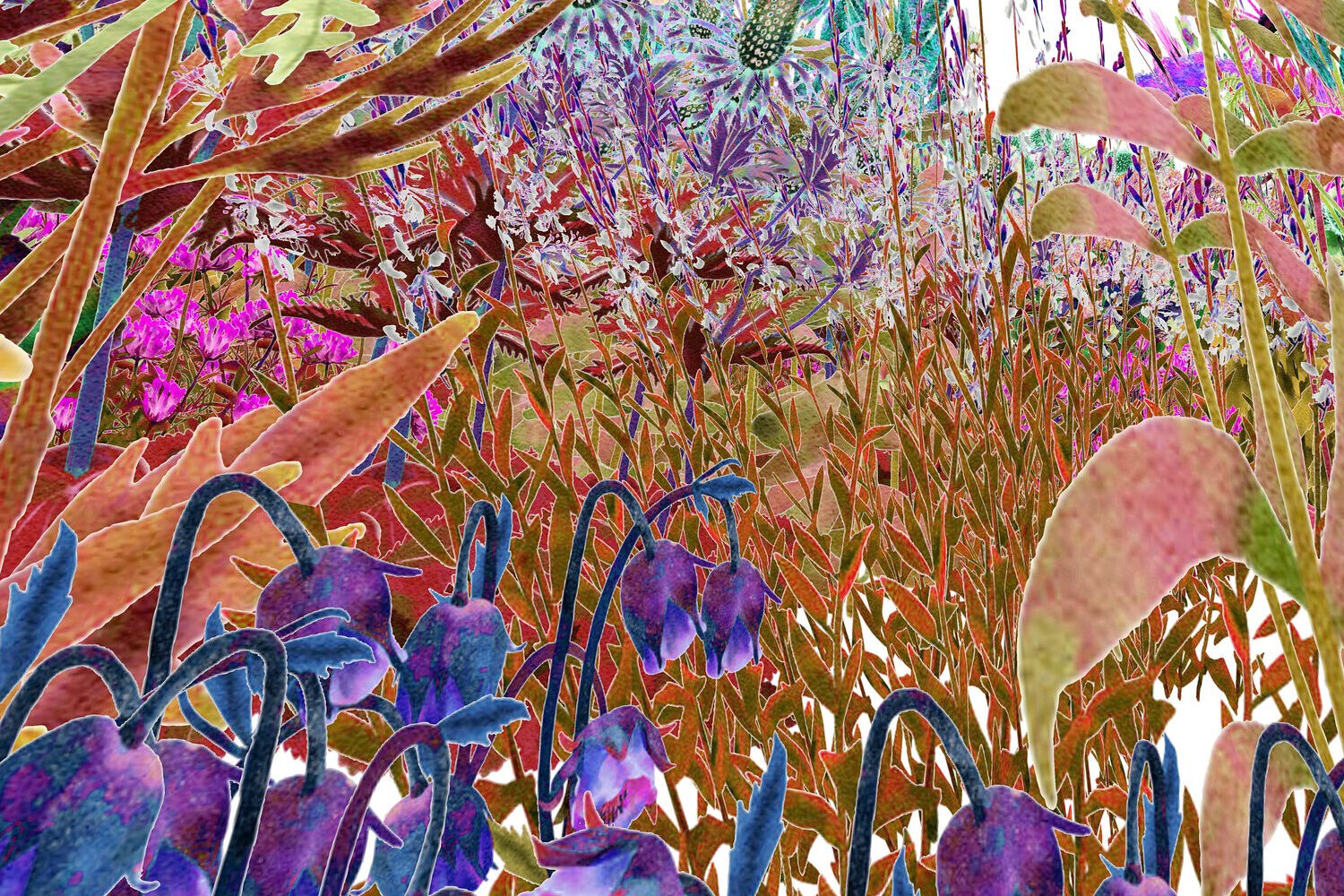
The project is a visionary and at the same time extremely practical example of how AI can help us promote biodiversity right on our doorstep, giving us a new sense of agency. What starts small and local is set to grow into something much bigger, says Alexandra Daisy Ginsberg: “My big goal is to create the largest climate-positive artwork to date—by sowing a network of pollinator artworks around the world.”
Combining creativity and fair business models
It is the deliberately fueled hype surrounding AI that links the technology so closely with Silicon Valley in our perception. No matter what we read or hear about AI, the news is almost always connected to a handful of companies spending billions to be the first to cross the finish line (which one, exactly?) in an unprecedented race. And it is these companies that claim the right to decide on “our” technology, its use, and the profits associated with it. Because they are financed through stock markets and venture capital, they must grow relentlessly—and in doing so, generate revenue rather than social progress.
But there are other possibilities, of course. Holly Herndon from the US, for example, has been working for years on how to use AI sensibly and build a business model around it that enables collaborative value creation and empowerment.
Together with the developers at VRO Labs in Barcelona and her partner Matthew Dryhurst, she developed “Holly+” in 2021 – a digital twin that can sing any song or melody in her voice with the help of AI. Anyone can upload an audio file to the Holly+ website and have it synthesized in her voice. This form of “protocol art,” as Holly Herndon herself calls her art, opens up fascinating artistic possibilities and “has great potential to become interesting to audiences in a collaborative way,” she says in the New York Times podcast.
But that’s only part of the story. The other part is about rights, co-determination, and profit sharing. All rights relating to Holly+ are managed by a Decentralized Autonomous Organization (DAO), whose members make collective decisions and reap the benefits. “As token holders, they are motivated to only certify or license new works that contribute to the value of the vote—and not dilute it by producing bad art or negative associations,” Holly Herndon writes on her blog. Revenue from usage and licenses flows back into the DAO and finances the further development of new tools. Approved Holly+ works are ultimately sold via the NFT auction platform Zora.
Holly Herndon is one of many artists who criticize Big Tech and its exploitative logic of progress, or theorize about how things could be done differently. Her work is proof of concept that we can indeed develop and use new technologies in ways that benefit everyone.
Renewing means repairing and moderating
No superintelligence from Silicon Valley will solve all our problems and turn our lives on Earth into paradise. Why? Because we are not failing due to ignorance—we know our problems, and we know the solutions. We just very often decide against them because comfort, profit, or power for some depend on the status quo.
Progress never comes from technology alone, but from people who use it wisely. Complex societies like ours cannot afford a “move fast and break things” philosophy. On the contrary, we have to repair our airplane while it is flying and keep all systems running while simultaneously improving and renewing them. If we don’t do that, we risk the collapse of our political system – and with it, any chance of positive development.
The future we want and need will not emerge from the boardrooms of large tech companies. It will grow in studios and workshops, in laboratories, offices, and classrooms—everywhere people use technology to solve their problems. Everywhere where people like Kentaro Yoshifuji, Pau Aleikum Garcia, Eliot Higgins, Alexandra Daisy Ginsberg, and Holly Herndon show that real progress requires not only expertise and creativity, but above all inclusion, empathy, and fairness. It is projects like theirs that make it clear that progress is much more than just technological innovation.